MicoAir
MicoAir MG-F10-C Dual-Band GNSS Module — L1+L5 Sub-Meter GPS, u-blox NEO-F10N, IST8310 Compass, Quad-Helix Antenna, for ArduPilot / PX4
MicoAir MG-F10-C Dual-Band GNSS Module — L1+L5 Sub-Meter GPS, u-blox NEO-F10N, IST8310 Compass, Quad-Helix Antenna, for ArduPilot / PX4
📦 Ships from our US or Canada warehouse — US delivery in 2–7 business days, duties & taxes prepaid · 🇨🇦 Canada: free shipping · 30-day returns
Couldn't load pickup availability
📘 Documentation & Guides
- MG-F10-C — Full User Manual — specifications, wiring, ArduPilot / PX4 setup, and a plain-English explainer of how dual-band GNSS works
Overview
The MG-F10-C is MicoAir's latest-generation dual-band GNSS positioning module, built around the u-blox NEO-F10N receiver and a high-gain 38 dB quad-helix antenna. It tracks four constellations (GPS, BeiDou, Galileo, NavIC) on two frequencies at once (L1 + L5) — the best positioning performance available short of full RTK, with 1.0 m CEP accuracy and measured static drift under 35–90 cm. An IST8310 magnetometer provides a stable heading reference, and a built-in supercapacitor delivers 2-second hot starts after battery swaps.
Why dual-band matters
Single-frequency (L1-only) GPS modules carry two error sources they physically cannot remove: ionospheric delay and multipath reflections. A dual-band receiver compares each satellite's L1 and L5 arrival times to cancel ionospheric error outright, while the newer, wider-bandwidth L5 signal is inherently resistant to multipath. The result is roughly 1 m accuracy instead of the typical 2–3 m, firmer position holds, and better velocity accuracy — which your flight controller's EKF uses on every loop. Ideal for long-range flights, fixed-wing aircraft, autonomous missions, and flying near terrain or structures.
Features
- u-blox NEO-F10N dual-band (L1 1575.42 MHz + L5 1176.45 MHz) receiver
- Concurrent GPS/QZSS, Galileo, BeiDou, NavIC + SBAS
- 1.0 m CEP positioning accuracy · 10 Hz max navigation rate
- IST8310 high-performance compass (I2C)
- 38 dB active 4-arm helix antenna — wide beam, strong multipath rejection
- Cold start 28 s · hot start 2 s (supercapacitor-backed)
- Sensitivity: −167 dBm tracking · operational limits 80 km / 500 m/s / 4 g
- PPS output pin + blue PPS LED (blinks on 3D fix)
- Flash parameter storage — settings survive power-off
- ArduPilot ≥ 4.4.0 and PX4 ≥ 1.14.0 support, plug-and-play as a standard u-blox GPS
Specifications
- Receiver: u-blox NEO-F10N · Compass: IST8310
- Signals: GPS/QZSS L1C/A+L5, Galileo E1-B/C+E5a, BeiDou B1C+B2a, NavIC SPS-L5, SBAS
- Supply: 5 V · 30 mA (module) / 55 mA (with antenna)
- UART: 115200 factory default, 3.3 V TTL, UBX-PVT output
- Connectors: GH1.25-6P (UART + I2C) and GH1.25-4P (PPS)
- Module: 29 × 44 × 14.7 mm, 13 g · Antenna: 28 × 28 × 59.3 mm, 15 g
- Operating temperature: −40 °C to +85 °C
Wiring & setup
Connect the 6-pin to a spare UART (RxD → FC TX, TxD → FC RX) plus SCL/SDA for the compass; power from 5 V. On ArduPilot: SERIALn_PROTOCOL = 5, GPS_TYPE = 1 (Auto) — defaults work on most boards. On PX4: connect to GPS1, auto-detected. Full parameter walkthrough in the user manual.
Package list
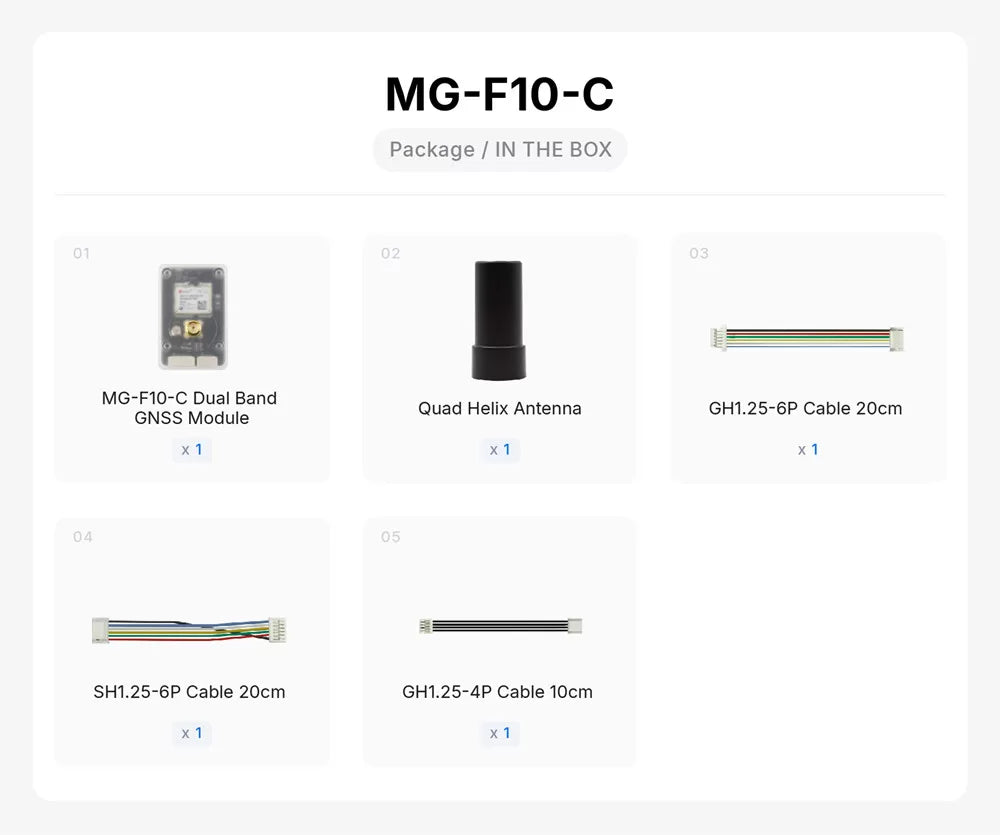
- 1 × MG-F10-C dual-band GNSS module
- 1 × Quad-helix antenna (SMA)
- 1 × GH1.25-6P cable, 20 cm
- 1 × SH1.25-6P cable, 20 cm
- 1 × GH1.25-4P cable, 10 cm
Technical Support
If you encounter any usage issues or require technical support after receiving your product, please feel free to contact us at support@robofusion.net. Our technical support team will respond within 48 hours. First-line answers for most setup questions are already in our knowledge base at docs.robofusion.net.
Share